
Mona Lisa Restoration
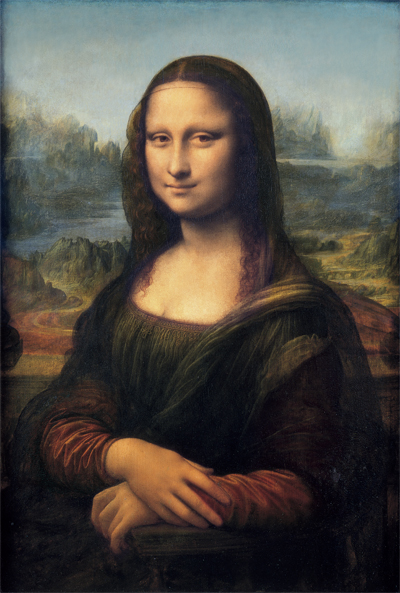
The image above is a digital restoration of a portion of the Mona Lisa. It is clear to see how the Mona Lisa currently on view at the Louvre has been affected by the yellowing of the varnish.
It is easy to imagine that the original colors could be easily restored by cleaning and restoring the surface varnish to prevent color changes caused by the varnish, but since the subject is the Mona Lisa, the Louvre is reluctant to do so.
In addition, the Louvre recently restored St. Anne and the Virgin and Child, both of which are in its collection, but many criticisms and questions have been raised about the restoration work, suggesting that the Louvre's approach to artworks is not necessarily monolithic and perfect.
In fact, when the paintings of St. Anne and the Virgin and Child were displayed after restoration, it was hard to shake the impression that the subtle shading had been lost, so it is understandable that there were criticisms that they had been over-cleaned.
Despite all this criticism and whistle-blowing, the Louvre has pushed ahead with the restoration work rather forcefully without taking any fundamental measures or reviewing its policies, which makes me question the attitude of the Louvre from the perspective of purely protecting artworks.
Currently, no specific plans have been announced for the Mona Lisa's restoration, but if the Mona Lisa is restored under the Louvre's current structure, there is a great risk of even greater confusion, criticism, and whistle-blowing than the previous restoration of the Virgin and Child with St. Anne.
Rather than physical deterioration over time, it may be said that the greatest disaster for the Mona Lisa is the human-made problems such as the conflicts of interest and financial issues surrounding it.
The truth about Mona Lisa
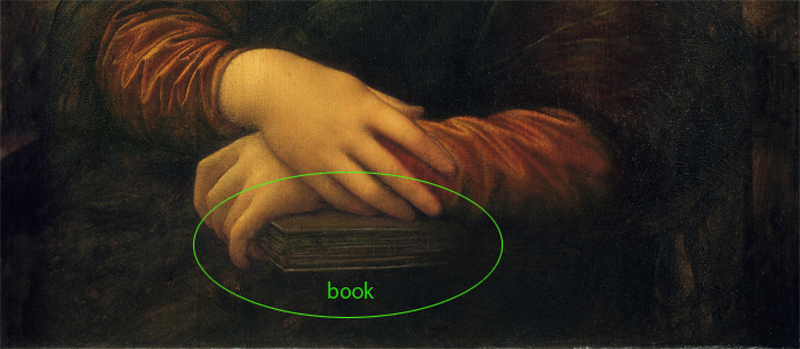
People around the world probably recognize the Mona Lisa as sitting in an armchair, in a relaxed position, with her left hand resting on the armrest. There is no doubt that Mona Lisa is now sitting in an armchair with her left hand resting on the armrest.
However, in my opinion, the place where Mona Lisa originally rested her left hand was not an armchair. So what exactly did Mona Lisa put her left hand on?
The answer is books.
The reason why I came to this conclusion is because I have doubts about the distorted and unnatural shape of the armchair in which Mona Lisa is sitting.
I believe that this chair has been repeatedly added to and its shape changed.
So what exactly did Leonardo add? The three pillars under his left hand. I believe that by adding three pillars here, Leonardo created an armrest that did not originally exist.
I feel that the painting is failing in the way these three added columns are connected to the linear column on the right edge of the painting.
The middle pillar of the three pillars lined up in a row is drawn slightly to the right, probably to create a sense of perspective with the pillars lined up in a straight line on the right. The arrangement of the pillars lined up and the pillars spaced apart in the foreground must be said to give a sense of unity.
 The image on the left is a CG version of the original Mona Lisa, with the colors adjusted and the numerous cracks on the screen corrected.
I think it looks pretty close to the state it was in right after it was painted by Leonardo.
The screen has been adjusted to be quite bright so as not to collapse, but even in this state, the area near the armchair at the bottom of the screen is covered in dark shadows, making it difficult to see what is being drawn.
 The image on the left is a modified version of the image above by further correcting the brightness, contrast, brightness, saturation, and color balance to make the armrest stand out as much as possible.
You can see that the columns on the right side of the screen are lined up in a straight line.
Furthermore, the linear columns are curved into a radius at the back of the screen, but their shape is also distorted, giving the impression that they were forcibly connected.
Another thing I feel is unnatural is the number of pillars. I feel that there are fewer pillars in the front compared to the pillars in the back. If it were me, I would draw about three more pillars on the front side and adjust the spacing between the pillars.
Addition process
1. Extend the right edge of the book under your left hand and connect it to the armrest on the right edge of the screen.
2. Add supports to the armrests.
3. Extend the back of the armrest on the right side of the screen in a circular arc.
4. Redraw the fingers of the left hand that were inserted into the book on the outside of the armrest.
Why a book?
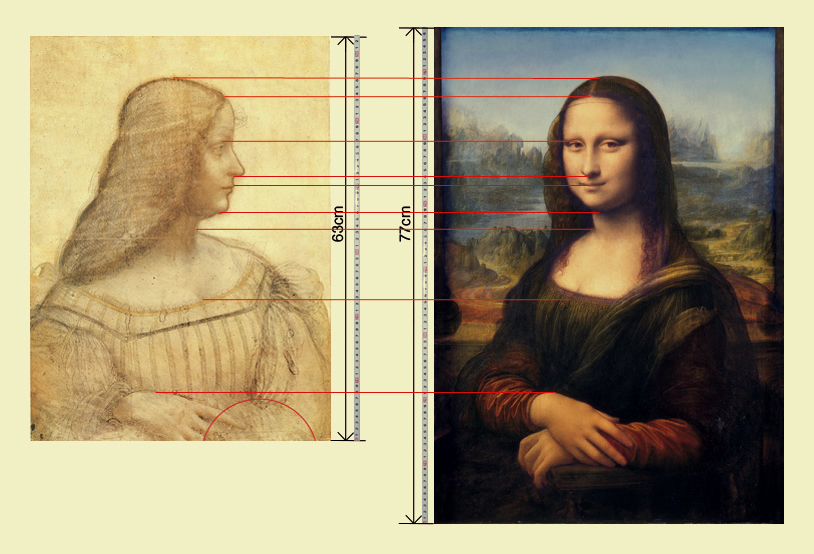
I started thinking that Mona Lisa might have had a book in her possession because of Leonardo's portrait drawing of Isabella d'Este.
The portrait drawing of Isabella d'Este, now in the Louvre, shows a book on the tips of the fingers of her right hand.
It may be a casual description, but I have a strong interest in this point. Because that was Isabella d'Este's specific order. She insisted that Leonardo include a book, a symbol of intelligence, in every portrait of her.
In other words, if Mona Lisa's model was Isabella d'Este, Mona Lisa should have a book.
 Comparison of portraits of Mona Lisa and Isabella d'Este
The vertical size of the Mona Lisa is 77 cm, while the vertical size of Isabella d'Este's portrait is 63 cm.The scale is adjusted so that each painting is 77 cm and 63 cm, and the images of Isabella d'Este are flipped horizontally and stacked. The combined image is shown on the left.
In this way, you can see that the proportions of Mona Lisa and Isabella d'Este are quite similar in portraits.
It feels like the Mona Lisa could be completed by simply turning Isabella's face, which was facing directly to the side, toward me.
I think it is quite possible that the countless transfer holes in this portrait were actually used to draw a rough sketch of the Mona Lisa.
In the portrait of Isabella d'Este below, the area where the book is drawn is surrounded by a red semicircle, but the angle of the book and the height of Isabella's left arm suggest that Isabella is probably sitting on a desk. It is assumed that he is depicted with his arms folded and a book in his hand. In other words, the scene is set in such a way that there is a desk in front of Isabella's body.
Now, in the current Mona Lisa, there is no desk depicted anywhere, and the arms appear to be set on the armrests of an armchair. However, in fact, there are still traces of the Mona Lisa having a desk in the past.
t is on the left edge of the screen, below the Mona Lisa's right elbow. There is a horizontal line drawn here, which divides the depiction of the veil. You can also see a black painted image diagonally downward from the edge of the divided veil.
I think that this part was originally supposed to be a desk, and that the part painted diagonally from the edge of the veil is the shadow part of Mona Lisa itself drawn on the desk. I am.
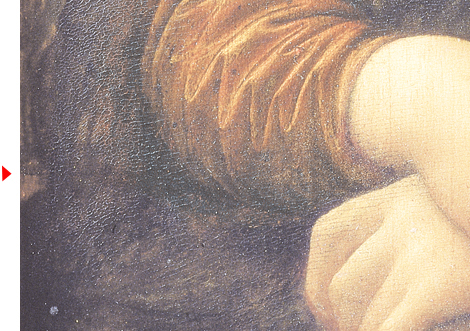 The image on the left is an enlarged view of the Mona Lisa's right elbow.
The image has been color-corrected using CG to highlight the horizontal line drawn next to the red triangle mark. You can also see that the veil portion drawn above this horizontal line is separated by this line.
Furthermore, the shadow-like area drawn diagonally downward from the left end of the veil gives the impression that it is not an accidental depiction, but a deliberate one.
Mona Lisa in its early stages
Until recently, the popular image and evaluation of the Mona Lisa was largely influenced by books. This is because the main medium of information transmission was paper. However, it is also true that in many cases the image quality could not be said to faithfully reproduce the state of the original painting.
In the last 20 years or so, the image quality has improved considerably, perhaps because the quality of the image data provided by the Louvre has improved, but before that, the equipment and technology used to photograph the Mona Lisa were poor. Perhaps because of this, the screen was unusually dark, and I felt that the color reproduction was often unreliable.
It is true that such low-quality reproductions have created many people's images of the Mona Lisa, and that the Mona Lisa theory has been based on that image.
In a sense, people who don't know the real Mona Lisa are discussing the Mona Lisa.
More recently, with the spread of the Internet, we have more opportunities to access image data that is quite faithful to the original, and the situation has improved significantly, but the important Mona Lisa is still unrestored and the colors are still very different from when it was painted. remain different.
What kind of painting is Mona Lisa?
Isn't pursuing that part the same as pursuing the Mona Lisa?
In the next step, I would like to consider the early stages of the Mona Lisa.
 The image on the left is a reproduction of the early stages of Mona Lisa's construction.
The painting he used as reference was St. Jerome in the Wilderness of the Vatican, and since this painting was abandoned during the early stages of production, it is an important document when examining the state of Leonardo's early production.
In terms of literature, we also refer to the report of Gianluigi Colalucci, who restored St. Jerome in the Wilderness.
According to a report by Gianluigi Colalucci, when Leonardo painted Jerome in the Wilderness, he used blue paint mixed with iron oxide for the light sketches, and dark brown paint (iron oxide) for the dark sketches. ). He also states that most of the shadows were painted with dark brown paint containing copper carbonate, and the sky and mountains were painted with azurite.
Indeed, it can be seen that in the restored St. Jerome, the upper body of the figure was sketched in a pale blue color, while the lower part of the painting was sketched in a dark brown color.
With this in mind, in the image on the left, the parts depicting people are drawn in a light blue tone, and the shadow areas and the bottom of the screen are drawn in a dark brown color.
Change screen configuration
Although the color has been restored as described above, there are three major differences in composition from the original Mona Lisa.
1. Changed the position of the columns in the background to shoulder height as seen in Raphael's sketch.
2. Add a table to the screen.
3. Add a book under the left hand.
I have already talked about adding tables and adding books, so here I will explain the position of the colonnade.
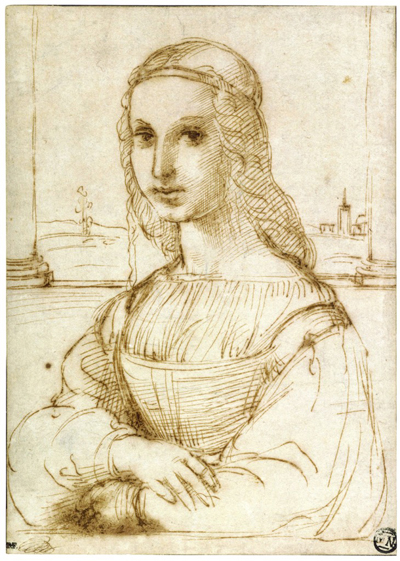
Raphael's drawing
Even now, more than 500 years later, we are still amazed at the coincidence of the fact that there is no one more dramatic than Raphael to witness the Mona Lisa.
What's more, the fact that he was able to sketch the Mona Lisa at that time, and that that sketch has survived to this day without being lost, can only be described as a miracle.
This sketch by Raphael is extremely simple. However, Raphael's ability as a painter is evident in his ability to capture Mona Lisa's characteristics so accurately.
The image below shows a comparison with the current Mona Lisa (digitally restored).
The biggest difference is probably the height of the pillars in the background. In Raphael's drawing, the column is placed much higher than the current position of the Mona Lisa. It also appears that Raphael was drawn in a free arrangement, without being particular about the position of the pillars. However, I believe that Raphael also accurately sketched the height of the columns.
It is my opinion that at the time Raphael sketched the Mona Lisa, the columns in the background of the Mona Lisa were drawn in this position.
Column position
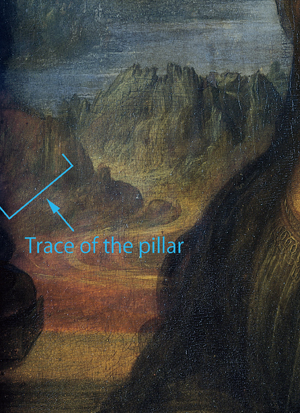
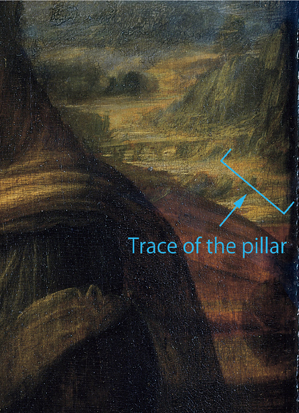
The diagram below shows where the pillars were originally drawn. A black shadow can be seen diagonally above the area indicated by the blue frame in the diagram. I assume that this part is the trace where a pillar was originally painted.
Furthermore, I believe that changing the position of this pillar and adding the background to the bottom created a unique atmosphere in the Mona Lisa's background. It is my opinion that the bird's-eye view and deep background of the Mona Lisa were created by such changes in composition.
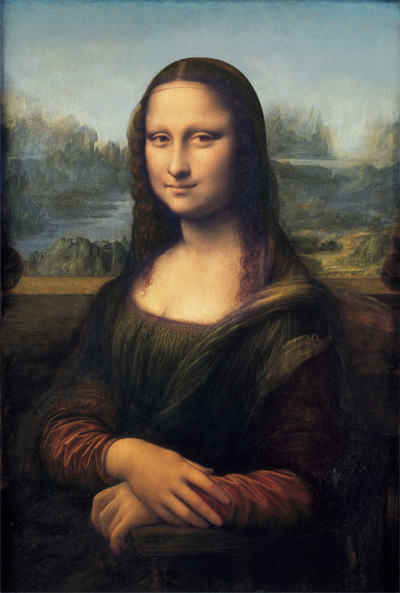 The image on the left is an image in which the position of the Mona Lisa pillar has been changed to the height of the pillar depicted in Raphael's drawing.
It is flatter, calmer and more stable than the original Mona Lisa.
The reason why the original Mona Lisa landscape gives me a somewhat unstable and uneasy feeling is that even though the background scenery is drawn from a perspective that looks down from a considerable height, the view behind the Mona Lisa is This is because the wall is so low that it gives the viewer the impression that they are about to fall through the opening.
The picture on the left gives a sense of security because the wall is high enough that it is difficult to imagine falling through the opening.
In a sense, it can be said that the repeated additions were the reason for the Mona Lisa's mysterious charm and characteristics.
Addition of veil
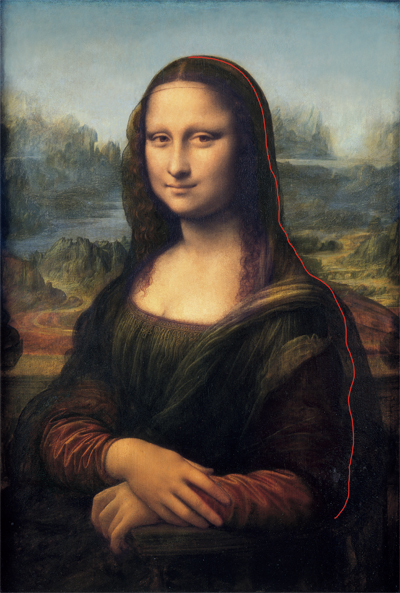
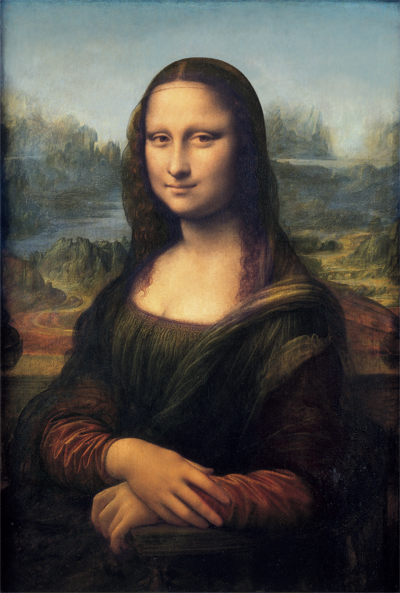
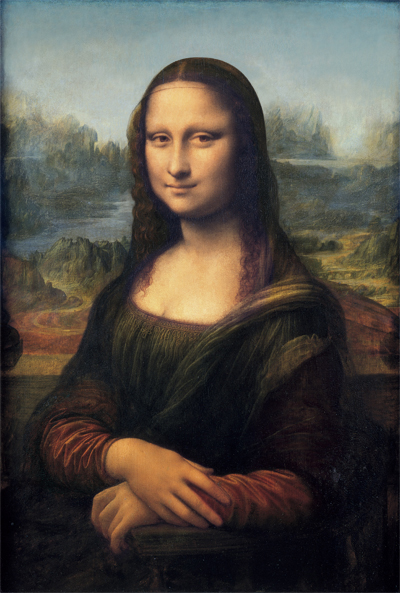
The image below is an image with the added parts of Mona Lisa's veil removed.
In the end, the Mona Lisa, with all the added parts removed, gives the impression of being quite slender. It is a simple depiction similar to the drawings by Raphael mentioned earlier.
The first cause of these additions is Leonardo's addition to the hair. As you add more details to the left side of the screen and around the right side of Mona Lisa's face, you will need to add more veils to the areas that cannot fit into the original veil.
Then, in order to balance the added left part, we now need to increase the volume on the opposite right side.
Added part on the right side
Remove the added part on the right side

Added part on the left
Removal of the added part on the left side

leonardoresearch.jp